Is a Mezzanine Floor Cheaper Than Moving Premises?
For many growing businesses, there comes a point when existing premises start to feel too small. Warehouses become overcrowded, production areas become inefficient, and storage capacity struggles to keep pace with demand.
At this stage, many business owners and operations managers begin asking the same question:
Should we move to larger premises, or can we create more space within our existing building?
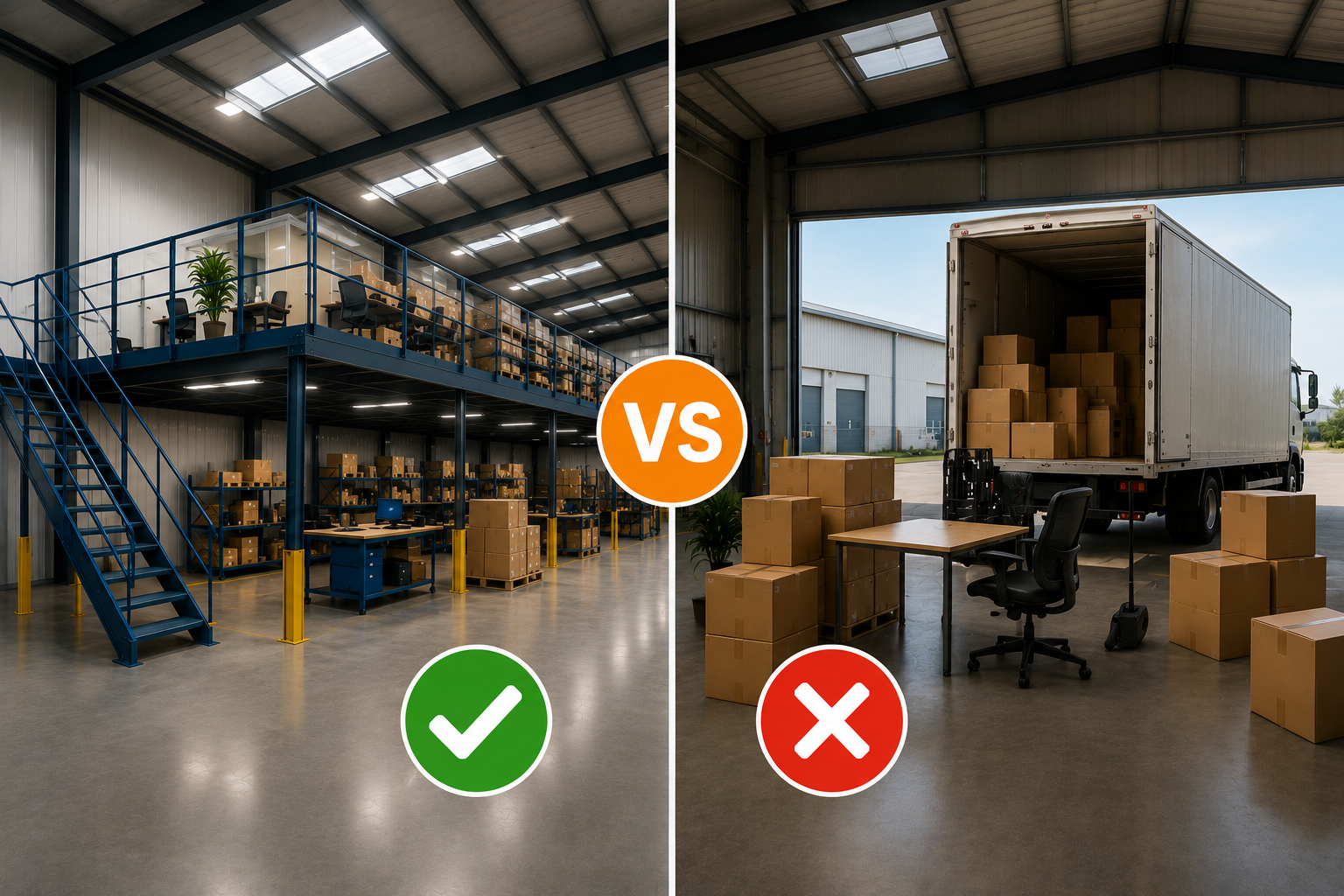
While relocating may seem like the obvious solution, it is often significantly more expensive and disruptive than businesses initially expect. In many cases, installing a mezzanine floor can provide the additional space needed at a fraction of the cost.
In this guide, we compare the costs of moving premises versus installing a mezzanine floor and explore why mezzanines have become one of the most popular warehouse expansion solutions in the UK.
The Real Cost of Moving Premises
When businesses evaluate relocation costs, they often focus on rent or mortgage payments. However, the true cost of moving is usually much higher.
Common relocation expenses include:
- New lease deposits
- Legal and professional fees
- Business rates adjustments
- Warehouse fit-out costs
- Moving equipment and machinery
- Stock relocation
- IT infrastructure installation
- New racking systems
- Downtime during the move
- Staff disruption and travel changes
These costs can quickly add up, particularly for manufacturing businesses, warehouses, and distribution centres.
Even relatively small relocations can result in tens of thousands of pounds in direct costs before productivity losses are considered.
The Hidden Cost of Operational Disruption
One of the biggest challenges associated with moving premises is disruption to day-to-day operations.
Relocation projects often involve:
- Reduced productivity
- Delayed shipments
- Temporary warehouse closures
- Staff training and adjustment periods
- Changes to workflows
- Customer service interruptions
For businesses operating within tight delivery schedules, even a short period of disruption can have a significant financial impact.
A mezzanine floor installation, by comparison, can often be completed with minimal interruption to ongoing operations.
How Much Does a Mezzanine Floor Cost?
The cost of a mezzanine floor varies depending on factors such as:
- Floor size
- Load requirements
- Building dimensions
- Staircase requirements
- Fire protection measures
- Building Regulations compliance
- Additional features such as pallet gates or goods lifts
While every project is different, a mezzanine floor is often substantially cheaper than relocating to a larger facility.
More importantly, it creates additional usable space within a building you already occupy.
How Much Space Can a Mezzanine Floor Add?
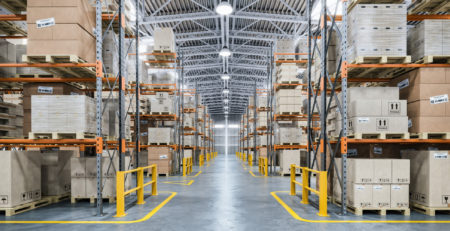
One of the major advantages of mezzanine floors is their ability to utilise unused vertical space.
Many warehouses have significant overhead clearance that contributes little to day-to-day operations.
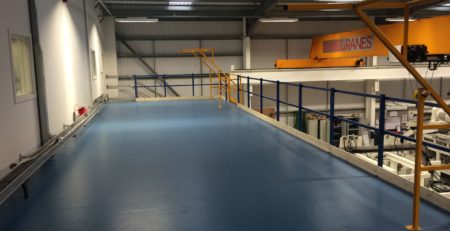
By installing a mezzanine floor, businesses can often create:
- Additional storage areas
- Picking and packing stations
- Production space
- Offices
- Staff welfare facilities
- Meeting rooms
Depending on the building layout, a mezzanine can effectively increase usable floor area by 50%, 100%, or even more.
Comparing Mezzanine Floors and Relocation
Initial Investment
Moving Premises
- Lease costs
- Legal fees
- Fit-out costs
- Moving expenses
- Infrastructure upgrades
Mezzanine Floor
- Design and engineering
- Manufacture
- Installation
- Building Regulations compliance
In most cases, the upfront investment for a mezzanine floor is considerably lower.
Speed of Implementation
Moving Premises
- Several months to find suitable premises
- Lease negotiations
- Fit-out works
- Relocation planning
Mezzanine Floor
- Design and approval process
- Manufacture
- Installation
Many mezzanine projects can be completed far more quickly than a full relocation project.
Business Disruption
Moving Premises
- High disruption
- Potential downtime
- Workflow changes
Mezzanine Floor
- Minimal disruption
- Existing operations remain in place
- No change of address
Long-Term Flexibility
Modern mezzanine systems can often be:
- Extended
- Reconfigured
- Relocated
- Adapted to changing requirements
This flexibility can be particularly valuable for businesses operating from leased premises.
Example Scenario
Imagine a warehouse business requires an additional 500 square metres of operational space.
Option 1: Move Premises
Potential costs may include:
- Lease deposit
- Legal fees
- Fit-out works
- Relocation costs
- Downtime
The total cost can easily exceed six figures depending on the location and scale of the move.
Option 2: Install a Mezzanine Floor
A mezzanine floor could potentially create the required additional space within the existing building while allowing operations to continue largely uninterrupted.
The result is increased capacity without the costs and disruption associated with relocating.
Additional Benefits of Mezzanine Floors
Cost savings are only one part of the equation.
Mezzanine floors also offer:
Improved Space Utilisation
Making better use of existing building height can dramatically improve efficiency.
Faster Return on Investment
Because installation costs are typically lower than relocation costs, businesses often see a faster return on investment.
Future Growth Potential
Many mezzanines can be expanded as requirements evolve.
Avoiding Relocation Risks
Moving premises introduces uncertainty and operational challenges.
Remaining within a familiar environment can help maintain business continuity.
When Moving Premises May Be the Better Option
Although mezzanine floors are highly effective, there are situations where relocation may still be necessary.
For example:
- The building has insufficient height.
- The site has outgrown its overall footprint.
- Additional loading bays are required.
- Yard space is limited.
- Significant operational changes are planned.
In these cases, relocation may provide greater long-term benefits.
However, many businesses discover that a mezzanine floor can delay or eliminate the need to move altogether.
Is a Mezzanine Floor Cheaper Than Moving Premises?
For many businesses, the answer is yes.
A mezzanine floor can provide substantial additional space without the costs, disruption, and uncertainty associated with relocation.
By making better use of existing building height, businesses can increase storage capacity, improve operational efficiency, and support future growth while remaining in their current premises.
Before committing to the expense of moving, it is often worth exploring whether a mezzanine floor could provide the additional space your business needs.
At Doity Engineering, we design, manufacture, and install mezzanine floors that help businesses across the UK maximise their available space while avoiding unnecessary relocation costs. Our innovative Revlok modular mezzanine system can be installed up to 50% faster than traditional mezzanine structures, providing a flexible and cost-effective solution for growing organisations.
FAQs
Is a mezzanine floor always cheaper than moving premises?
In many cases, yes. A mezzanine floor typically involves lower upfront costs and less disruption than relocating to a larger building.
How much space can a mezzanine floor create?
Depending on the building layout and available height, a mezzanine floor can significantly increase usable floor space and in some cases effectively double it.
How long does it take to install a mezzanine floor?
Installation times vary, but many mezzanine projects can be completed within days or weeks rather than the months often associated with relocation.
Can a mezzanine floor be installed in a leased building?
Yes. Many mezzanine floors are installed in leased premises and can often be modified or relocated if business requirements change.
When should a business consider moving instead of installing a mezzanine?
Relocation may be more suitable when the building lacks sufficient height, requires additional yard space, or can no longer support future operational requirements.