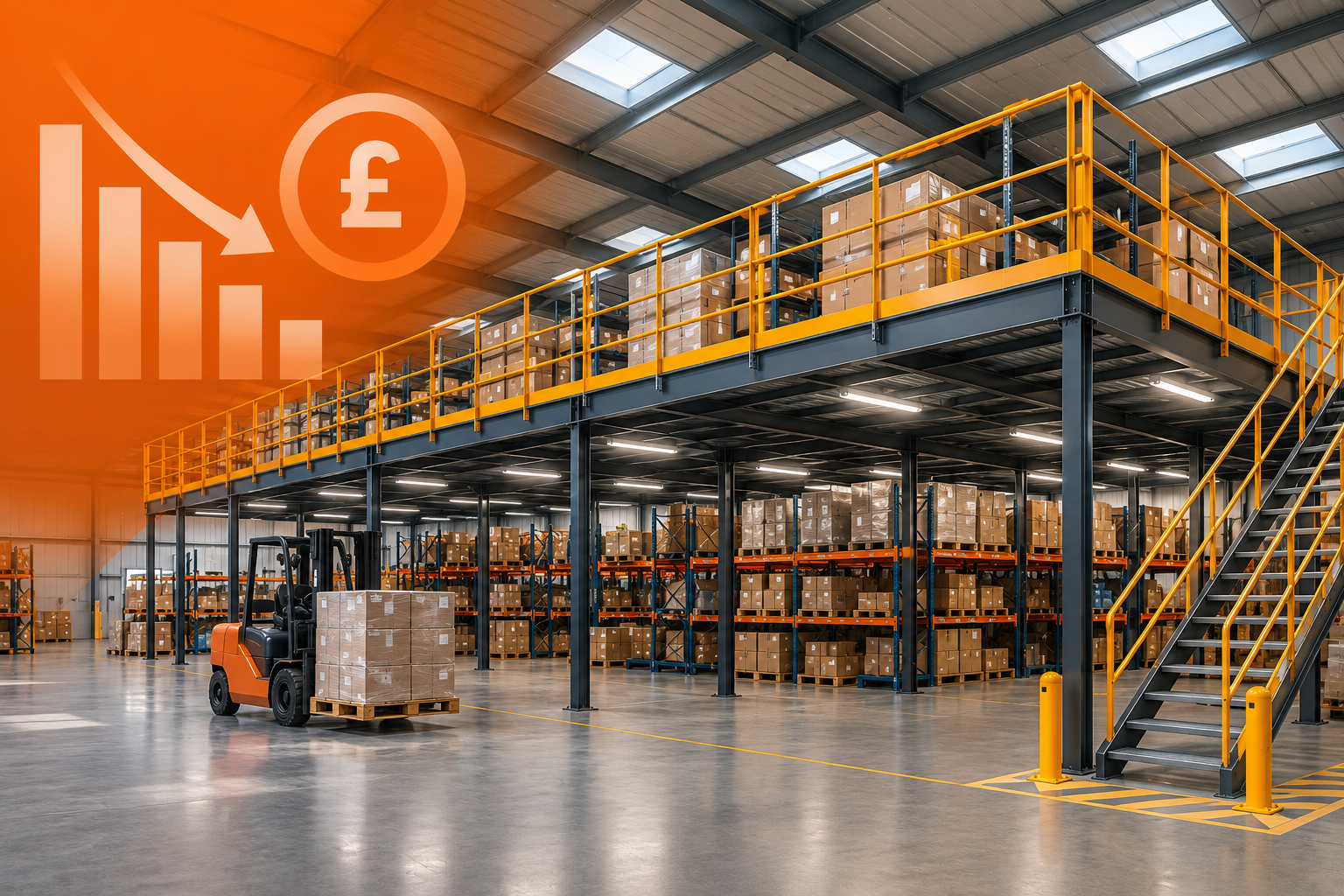
Can a Mezzanine Floor Help Reduce Warehouse Operating Costs?
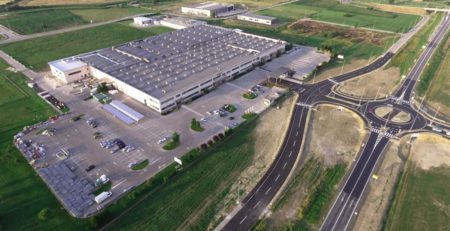
When a business starts running out of warehouse space, moving to larger premises can seem like the obvious solution. However, a bigger warehouse can also bring higher rent, business rates, energy costs and other ongoing overheads.
Before relocating, it is worth considering whether you could make better use of the space you already have.
A mezzanine floor allows you to create additional usable space within your existing building, potentially increasing storage or operational capacity without increasing the overall footprint of your premises.
So, can installing a mezzanine floor actually help reduce warehouse operating costs?
Can a Mezzanine Floor Reduce Warehouse Operating Costs?
A mezzanine floor can help reduce warehouse operating costs by allowing a business to make better use of its existing premises. Creating additional storage, production or working space within the current building may help avoid or delay relocation, reduce the need for additional premises and improve warehouse efficiency. The potential savings will depend on the building, mezzanine design and how the additional space is used.
Making Better Use of the Warehouse You Already Have
One of the biggest opportunities in many warehouses is above the existing operation.
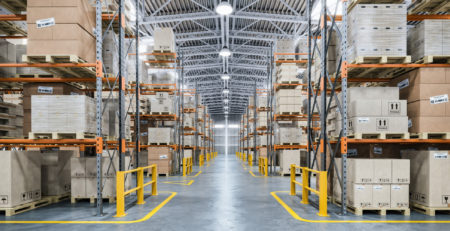
Industrial buildings often have substantial clear height, yet storage, production and other activities remain concentrated at ground-floor level.
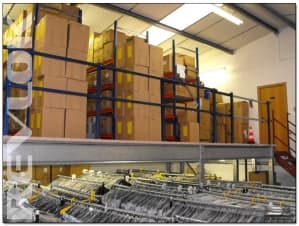
A mezzanine floor uses this vertical space to create another usable level.
Instead of paying for a larger building simply to gain more floor area, businesses may be able to create the additional capacity they need within their current premises.
Delaying the Cost of Moving Premises
Relocating a warehouse can involve considerably more than simply paying higher rent.
Businesses may also need to consider:
- Removal and transport costs
- Installation of equipment
- New racking or storage systems
- IT and infrastructure changes
- Operational downtime
- Changes to utilities and services
- Staff and logistics implications
There may also be considerable disruption while the business transitions from one facility to another.
If the existing warehouse is otherwise suitable, installing a mezzanine floor could allow the business to remain there for longer while gaining the additional space it needs.
Reducing the Need for Additional Warehouse Space
Another common response to running out of room is to rent additional storage elsewhere.
While this solves the immediate capacity problem, operating from multiple locations can create additional costs and complexity.
Stock may need to be transported between sites, inventory becomes more difficult to manage and employees may spend additional time locating or moving goods.
Creating more capacity within the existing warehouse can help keep more of the operation under one roof.
Can a Mezzanine Improve Warehouse Efficiency?
The financial benefit of a mezzanine isn’t necessarily limited to property costs.
A well-designed mezzanine can also help improve the way a warehouse operates.
For example, additional floor space could be used to create dedicated areas for:
- Storage
- Picking and packing
- Production
- Assembly
- Offices
- Staff facilities
Separating different activities can help reduce congestion and create a more organised workflow.
The mezzanine should therefore be designed around how the business operates rather than simply creating the maximum possible floor area.
Freeing Up Valuable Ground-Floor Space
Not every activity needs to occupy valuable ground-floor warehouse space.
Offices, archive storage, lighter stock and staff areas may potentially be moved onto a mezzanine, freeing the space underneath for operations that benefit from direct ground-floor access.
For a warehouse, that could mean creating more room for:
- Pallet storage
- Machinery
- Forklift movements
- Goods-in and dispatch
- Production lines
Using each part of the building more effectively can increase the capacity of the warehouse without increasing its external footprint.
Supporting Business Growth Without Increasing Your Footprint
Growing businesses often reach a point where their existing warehouse begins to feel too small.
However, increasing turnover doesn’t necessarily mean you immediately need a larger building.
If sufficient height is available, a mezzanine floor can provide room for additional stock, employees or operational processes while allowing the business to continue working from the same premises.
This can be particularly valuable when a business expects further growth but isn’t yet ready to commit to significantly larger premises.
Could a Mezzanine Reduce Picking and Handling Costs?
Potentially.
The important factor is how the mezzanine is designed.
If stock and operational areas are poorly organised, employees may spend unnecessary time walking between locations or moving goods around the warehouse.
A carefully planned mezzanine can help create dedicated zones and position stock or processes more logically.
However, simply adding another floor does not automatically improve efficiency. Access, stairs, pallet gates, goods movement, racking and workflow all need to be considered as part of the design.
What About Energy Costs?
A mezzanine floor does not automatically reduce energy consumption.
However, making better use of an existing building could potentially avoid the need to operate a larger facility or additional warehouse solely because more floor space is required.
The overall financial impact will depend on the individual premises and how the additional space is used.
This is why businesses should consider the total cost of occupying and operating a warehouse, rather than comparing property size alone.
Mezzanine Floor vs Moving to a Larger Warehouse
When additional space is required, it is worth comparing the long-term costs of both options.
Moving premises may be appropriate if the existing building can no longer support the needs of the business.
But if the main problem is simply a lack of usable floor space, a mezzanine could provide a more practical alternative.
Businesses should consider:
- The cost of the mezzanine
- Remaining lease term
- Cost of larger premises
- Business rates and utilities
- Relocation costs
- Potential downtime
- Additional capacity created
- Future growth requirements
Looking at the complete picture can help determine which option offers better long-term value.
Designing for Future Expansion
A mezzanine can also be designed with future requirements in mind.
For growing businesses, this is particularly important.
Depending on the system and original design, it may be possible to modify or extend a mezzanine as requirements change.
Doity Engineering’s Revlok modular mezzanine system provides additional flexibility, helping businesses create a structure that can adapt alongside their operations.
Planning for future growth from the beginning can help businesses avoid repeatedly changing their warehouse layout as their space requirements increase.
Is a Mezzanine Floor a Good Investment?
The answer depends on the individual business.
A mezzanine floor represents an upfront investment, so the potential benefits should always be considered against the cost of alternative solutions.
For a business that has significant unused vertical space but is running out of floor area, a mezzanine can provide considerable additional capacity without requiring a larger building.
The business case becomes particularly compelling where the alternative would involve relocating or taking on additional premises.
Making Your Existing Warehouse Work Harder
Before committing to a larger warehouse, it is worth understanding whether your existing building is being used to its full potential.
At Doity Engineering, we design and manufacture mezzanine floors around the requirements of each business, considering not only the amount of additional space required but also how that space can support efficient day-to-day operations.
By making better use of existing vertical space, a mezzanine floor could help increase capacity, improve warehouse efficiency and potentially avoid some of the costs associated with moving or operating additional premises.
Frequently Asked Questions
Can a mezzanine floor save a business money?
Potentially. A mezzanine floor can create additional usable space within an existing building, which may help a business avoid or delay the costs associated with moving to larger premises or renting additional warehouse space.
Is a mezzanine floor cheaper than moving warehouse?
In many situations, installing a mezzanine can be more cost-effective than relocating, particularly when the existing building is otherwise suitable. However, the costs and long-term requirements of each option should be assessed individually.
Can a mezzanine floor improve warehouse efficiency?
Yes. When properly designed, a mezzanine can help separate different activities, improve organisation and create dedicated areas for storage, picking, packing, production or offices.
Can a mezzanine floor reduce the need for additional storage?
Yes. By making use of unused vertical space, a mezzanine can increase storage capacity within an existing warehouse and potentially reduce the need to rent additional storage elsewhere.
Should I install a mezzanine or move to a larger warehouse?
This depends on your available building height, future growth plans, operational requirements and the costs involved. If your existing premises are suitable apart from limited floor space, a mezzanine may provide an alternative to relocation.